
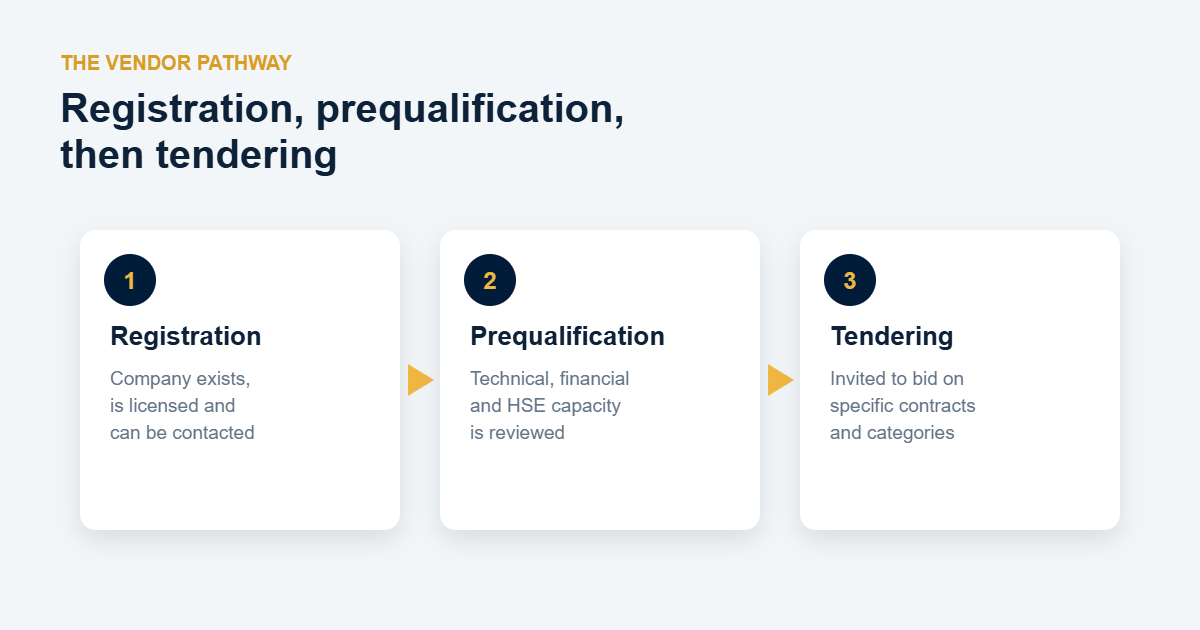
Vendor registration and prequalification often get treated as the same thing, but they check different things at different points in the buying relationship. Registration confirms that your company legally exists, is properly licensed and can be paid and contacted. Prequalification is a deeper review that decides whether your company is capable, financially sound and safe enough to actually be invited to bid on real work.
Understanding the difference matters because the two steps ask for different documents, take different amounts of time, and sit at different points in the process. Confusing them is one of the more common reasons companies prepare the wrong paperwork or apply for the wrong thing first. The diagram below shows how the two processes typically connect, and the rest of this guide walks through each stage in detail.
What vendor registration actually covers
Registration is usually the first and simplest step in dealing with a Saudi organization. When you register as a vendor or supplier, you are mainly proving three things: that your company legally exists, that it is licensed for the activities you claim to offer, and that there is a working contact point and bank account to deal with. The organization typically collects your commercial registration, tax and Zakat details, GOSI status, a company profile, and basic banking information, then issues a supplier number or a portal account.
Registration on its own does not promise any work. It puts your company into the buyer’s system so that when a relevant opportunity comes up, the buyer can find you and invite you to take part. Most organizations keep registration open on a rolling basis, so a new company can usually join the list at almost any time rather than waiting for a specific window.
Registration portals also vary in how much detail they ask for up front. Some only need your legal and tax documents plus a short company profile. Others ask you to select specific supply categories, upload sample certificates, or nominate a primary contact who will receive tender notifications. None of this changes the underlying purpose of registration though, which is simply to confirm who you are and that you are legally able to trade.
What prequalification adds on top
Prequalification goes further. Instead of checking that your company exists, it checks whether you are actually fit to perform the specific type of work or supply category you are applying under. This usually means submitting audited financial statements, project references, technical capability details, health and safety records, and quality certifications such as ISO 9001, sometimes alongside a minimum financial capacity tied to the size of contracts you want to bid on.
Because prequalification is more detailed, it is usually tied to a category or scope rather than to the company as a whole. A contractor might be prequalified for civil works but not for electrical works, for example, and each category can carry its own financial and technical thresholds. Prequalification is also where most Saudi organizations formally assess local content and Saudization commitments, since these count toward the buyer’s own compliance targets under programs such as Nitaqat.
A prequalification review usually looks at four broad areas. Technical capability covers your track record on similar work, the qualifications of your staff, and the equipment or systems you can bring to a project. Financial capacity looks at your revenue history, profitability and debt levels, sometimes against a minimum threshold tied to contract size. Health, safety and environment review covers your safety statistics, management systems and any incident history. Quality and compliance covers certifications, local content planning and any sector-specific licenses your category requires. A weak result in any one of these areas can hold back the whole application, even if the others are strong.
How the two steps fit together
In practice, registration comes first and prequalification comes after, when there is a specific reason to assess a supplier more closely, such as a category you want to bid in or a contract size that requires a deeper review. A company can stay registered for years without ever going through prequalification if it never bids on work that requires it. Prequalification, on the other hand, almost always assumes you are already registered, since the buyer needs your basic company record before running a more detailed review on top of it.
This is worth planning for early. If you already know you want to bid on larger contracts eventually, it helps to prepare prequalification-level documents, audited financials and project references included, while you are still going through basic registration, rather than assembling them under pressure when a tender deadline is close.
It also helps to think of the two steps as separate gates rather than a single application. Registration gets you into the room. Prequalification decides which specific rooms you are allowed into. A company can be registered with dozens of organizations at once but only prequalified for a handful of categories across a smaller number of them, and that is a completely normal outcome rather than a sign of a weak application.
Many large Saudi organizations now run both registration and prequalification through digital procurement platforms rather than paper submissions, with SAP Ariba being one of the more common systems in use. These platforms usually keep your registration data, your prequalification status by category, and your live tender invitations in one place, which makes it easier to track renewal dates but also means an outdated or inconsistent record in the system can affect every category you are tied to at once. If you are setting up a profile on one of these platforms for the first time, our SAP Ariba registration guidance covers the setup steps in more detail.
Registration and prequalification across different supplier types
The general process is the same for most supplier types, but what gets reviewed in detail shifts depending on what you actually supply. It helps to know what buyers tend to focus on for your category before you apply.
المقاولونs are usually reviewed most heavily on project references, technical staff, equipment ownership or access, and HSE performance, since their work happens on site and carries direct safety exposure. Material and equipment suppliers tend to be assessed more on manufacturing or distribution capacity, quality certifications, and the ability to meet delivery schedules at scale. Service providers, including consultants and specialized technical firms, are usually judged on staff qualifications, methodology and past engagements rather than physical assets. القوى العاملة and labor supply companies are typically reviewed closely on Saudization ratios, GOSI compliance and labor law adherence, since these carry direct legal exposure for the buyer.
None of this changes the basic sequence of registration followed by prequalification, but it does change how much weight each part of the review carries, so it is worth tailoring your documentation to what matters most for your specific category rather than submitting a generic package to every organization.
How long each stage typically takes
Registration is usually the faster of the two steps, since it is mostly a document and eligibility check rather than a technical review. Many portals can process a complete registration application within a few working days to a couple of weeks, assuming all documents are valid and consistent with each other.
Prequalification takes longer because a real person or committee has to evaluate your financial statements, references and technical submission, and may come back with questions or requests for additional evidence. Processing times vary significantly between organizations and categories, and can extend further if your application is incomplete or if the reviewer needs clarification. Because of this, it is worth starting the prequalification process well before you need to bid on a specific tender rather than treating it as something you can complete at the last minute.
If a tender deadline is approaching and you are not yet prequalified for the relevant category, it is worth checking directly with the buyer whether an expedited review is possible, rather than assuming the standard timeline will apply.
Documents checklist for each stage
For basic registration, most Saudi organizations ask for a similar core set of documents. Our full documents guide covers this in more detail, but at minimum expect to prepare:
- Commercial Registration (CR) showing your legal name and activities
- VAT registration certificate, where applicable
- Zakat and tax certificate from ZATCA
- GOSI certificate showing your social insurance status
- Chamber of Commerce membership certificate
- Company profile and bank confirmation or IBAN letter
For prequalification, organizations typically ask you to also prepare:
- Audited financial statements, usually for the last two to three years
- Project references and completion certificates for similar work
- Technical staff CVs and equipment lists where relevant to the category
- Health, safety and environment records and certifications
- Quality certifications such as ISO 9001
- Saudization or Nitaqat status and any local content commitments
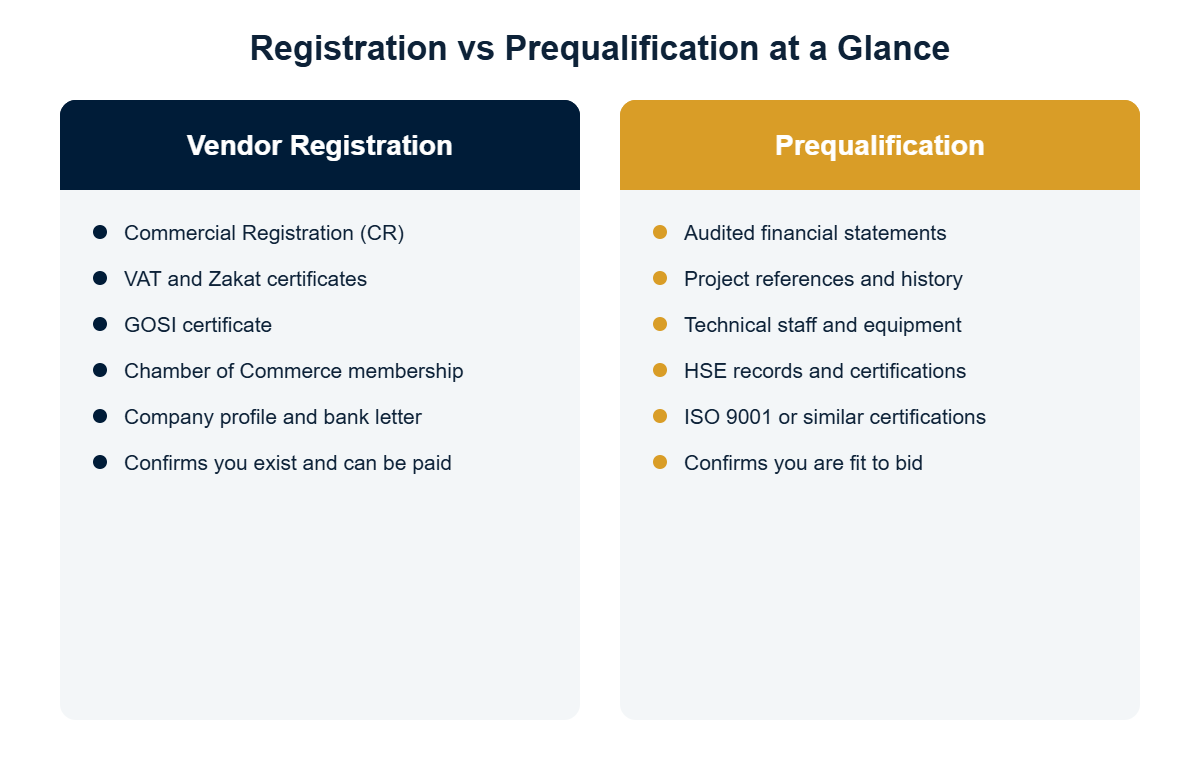
It is worth keeping both lists on file as living documents rather than one-time submissions, since several of these certificates expire and need to be reissued or reuploaded over time.
Costs and internal resources to plan for
Registration itself is usually free or low cost to submit, though you may need to pay separately for issuing or renewing some of the underlying certificates, such as Chamber of Commerce membership or certain government certificates. Prequalification does not usually carry a direct application fee either, but it does carry a real internal cost in staff time, since preparing audited financials, reference letters and technical write-ups properly takes meaningful effort, especially the first time.
It is worth assigning clear ownership internally for both processes rather than treating them as a side task. A single point of contact who tracks certificate expiry dates, gathers project references as they are completed, and keeps financial statements audit-ready will save considerable time compared to assembling everything reactively when an opportunity appears.
Smaller companies without a dedicated procurement or compliance team sometimes bring in outside help to prepare their registration and prequalification documentation, particularly for their first few submissions or when applying to several organizations at once. This can be worthwhile if it frees up management time or catches formatting and consistency issues before submission, but it does not change the underlying requirements. The buyer still evaluates the same financial and technical evidence regardless of who helped assemble it, so the priority should always be accuracy and consistency rather than presentation alone.
Common mistakes companies make
The most common mistake is applying for prequalification before the basic registration documents are in order. If your commercial registration, tax status or GOSI record has an inconsistency, it will usually surface during prequalification review and cause delays that could have been avoided earlier.
Another frequent issue is applying for a category that does not match the company’s actual experience or financial capacity, then being surprised when the application is rejected or downgraded. It helps to be realistic about which category and contract size your company can genuinely support before applying, since a rejected application can affect your standing for future attempts. Reviewing your documentation against the specific category requirements beforehand, something covered under registration documentation review, tends to catch these mismatches earlier.
Companies also sometimes treat registration as a one-time task and let certificates lapse afterward. A tax certificate, GOSI status or ISO certification that expires mid-project can hold up payments or disqualify you from ongoing prequalification, so it is worth tracking renewal dates for every document used in either process.
Another mistake is submitting inconsistent figures across documents, for example a revenue figure in your financial statements that does not match what is stated in your company profile or previous submissions. Reviewers tend to treat inconsistencies as a red flag even when they are simple clerical errors, so it is worth having one person check all documents together before submission rather than assembling them separately.
Finally, many companies underestimate how long prequalification takes compared to registration, and start the process too close to a tender deadline. Because prequalification involves a real technical and financial review rather than a form check, it typically takes longer, so starting early gives you room to correct anything the reviewer flags.
Keeping your status current
Getting registered and prequalified is not a one-time achievement. Most organizations expect vendors to keep their records current, which usually means resubmitting updated financial statements annually, renewing certificates before they expire, and notifying the buyer of major changes such as a change in ownership, a new line of business, or a significant change in financial position.
Some organizations run periodic re-qualification cycles where prequalified vendors are reassessed on a set schedule, while others rely on vendors to proactively update their file. Either way, letting your status lapse can mean losing eligibility for tenders you would otherwise have qualified for, so it is worth building a simple internal calendar of renewal dates rather than waiting for a reminder from the buyer.
Frequently asked questions
Is vendor registration the same as being an approved supplier?
No. Registration means your company is in the buyer’s system and can be considered. Approved or prequalified status means the buyer has reviewed your technical and financial capability and cleared you for a specific category of work.
Do I need to be prequalified before I can register?
No, it works the other way around. Registration is normally the entry step, and prequalification is a further review that comes after, usually when you want to bid on a specific category or contract size.
How long does prequalification usually take compared to registration?
Registration is typically faster since it mainly checks documents and legal status. Prequalification takes longer because it involves a technical and financial review, and timelines vary by organization, so it is best to confirm the current processing time directly with the buyer.
Can a registered vendor lose prequalified status later?
Yes. Prequalification is usually tied to specific documents and certifications that can expire or change, such as financial statements, insurance or quality certifications. Keeping these current is necessary to remain prequalified, even if your basic registration stays active.
Can a small or newly formed company go through prequalification?
Yes, though newer companies may need to apply for smaller contract sizes or categories until they build up audited financial history and project references. Some organizations offer separate pathways or lower thresholds for smaller vendors, so it is worth checking category-specific requirements rather than assuming a minimum company age applies everywhere.
Does prequalification in one category carry over to another?
Not automatically. Because prequalification is usually tied to a specific scope of work, a company prequalified for one category, such as material supply, would typically need a separate review to be prequalified for a different category, such as contracting or technical services, even with the same buyer.
Does being prequalified with one organization help with another?
It can help indirectly, since project references, financial statements and certifications you already hold from one prequalification are often reusable evidence for another. It does not automatically transfer your approved status though, since each organization runs its own independent review, even if the supporting documents overlap significantly.
Requirements and processing times vary by organization and change over time, so always confirm current requirements on the relevant official portal. Meeting the documented requirements does not guarantee approval.
هل أنت مستعد لتجهيز تسجيلك؟
اختر جهة وفئة مورد، ثم تابع إلى بوابة التسجيل الآمنة لدى وزير سوليوشن.
تصفح الجهات →